
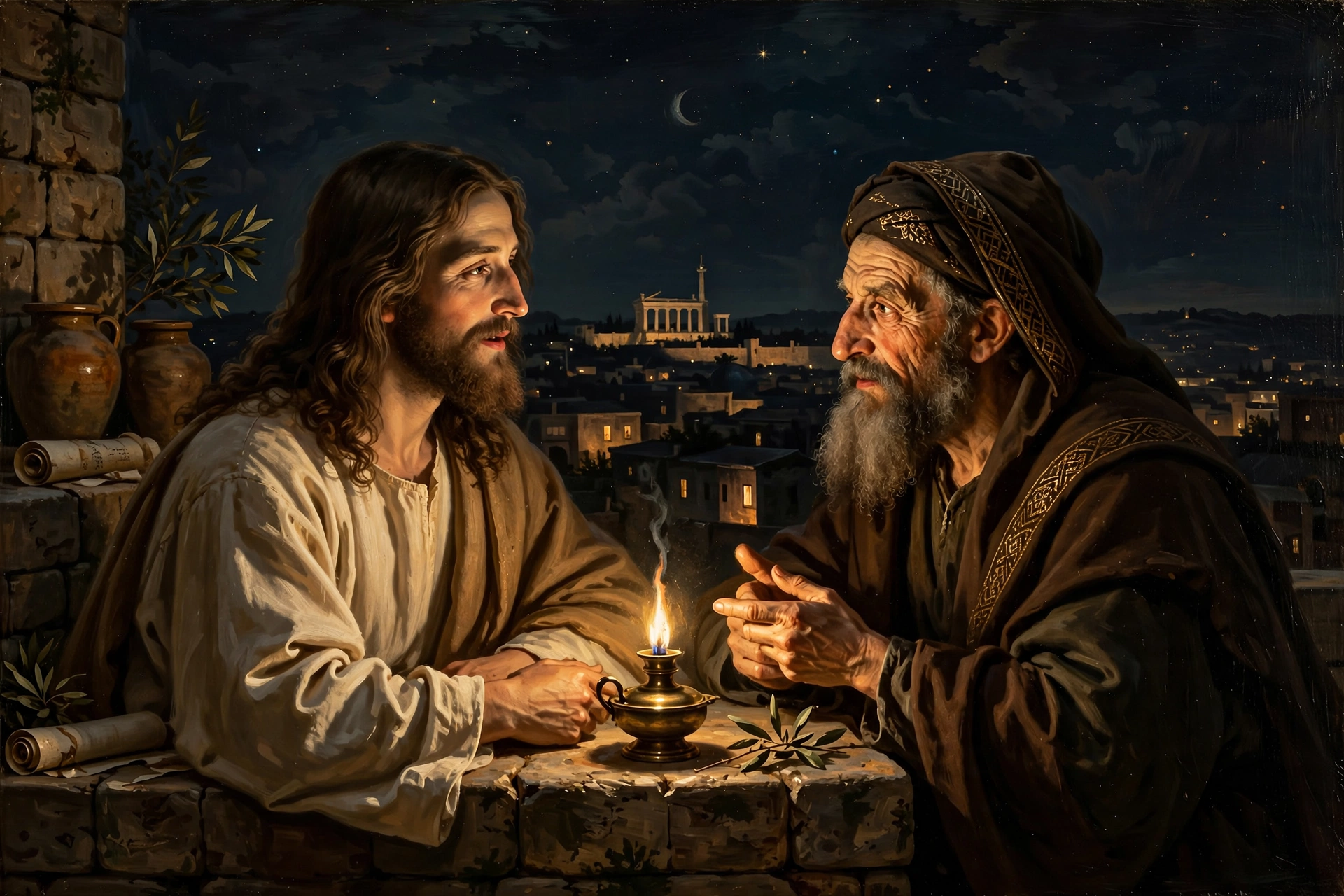
John 3 – Historical and Spiritual Context
John chapter 3 serves as the theological heartbeat of the Fourth Gospel, marking a radical shift from the external religious expectations of first-century Judaism to the internal transformation required by the Kingdom of God. The narrative begins under the shroud of night, where Nicodemus—a Pharisee and member of the Sanhedrin—seeks out Jesus. This setting is symbolic; Nicodemus approaches Jesus in the darkness of his own spiritual confusion, representing the intellectual elite of Israel who possessed the law but lacked the life-giving Spirit. John’s intent is to contrast the rigid, ritualistic adherence to the Mosaic Law with the fluid, sovereign, and mysterious nature of the New Birth. By placing this encounter early in his Gospel, John establishes that religious pedigree is insufficient; one must experience a fundamental re-creation initiated by God.
The overarching spiritual theme of this chapter is the transition from “religion” to “regeneration.” As the dialogue moves from the private instruction of Nicodemus to the public ministry of John the Baptist, the text pivots toward the ultimate manifestation of God’s character: self-sacrificial love. John presents Jesus not merely as a teacher, but as the heavenly representative who must be “lifted up” to provide the remedy for the human condition. The chapter moves the reader from the confusion of the night to the clarity of the Cross, emphasizing that the barrier between humanity and God is not bridged by human effort or moral improvement, but by faith in the One who descended from heaven to save a world that could not save itself.
Detailed Verse-by-Verse Commentary
Study of John 3:3
**”Jesus answered and said to him, ‘Most assuredly, I say to you, unless one is born again, he cannot see the kingdom of God.'”**
In this verse, Jesus introduces the concept of the *anothen* birth. In Greek, *anothen* carries a double meaning: it means both “again” and “from above.” Nicodemus focuses on the physical impossibility of a second biological birth, but Jesus is pointing to a supernatural origin. To “see” the kingdom is to perceive the spiritual reality of God’s reign, which is impossible for the “flesh” (human nature in its fallen state). The theological implication is profound: human effort, intellect, and religious tradition are incapable of perceiving God’s kingdom. We require a divine intervention—a spiritual impartation of life—that originates from the Father, effectively making us new creatures with a new nature.
Study of John 3:16
**”For God so loved the world that He gave His only begotten Son, that whoever believes in Him should not perish but have everlasting life.”**
This is arguably the most famous verse in Scripture, often called the “Gospel in a nutshell.” The Greek word for “loved” here is *agape*, which signifies a sacrificial, unconditional, and choosing love. The phrase “so loved” (*houtos agapesen*) implies the *degree* of His love; it is a love that compelled the Father to give His unique, “one-of-a-kind” Son (*monogenes*). The verse shatters the exclusivity of the Jewish nationalistic hopes of the time, declaring that the target of God’s love is the *kosmos*—the entire fallen world. The response required is *pisteuo* (belief), which in the biblical context is not mere intellectual assent, but a total, trust-filled reliance on the person and work of Jesus Christ.
Study of John 3:30
**”He must increase, but I must decrease.”**
These words from John the Baptist serve as the ultimate posture for the believer. As the “best man” to the Bridegroom (Jesus), John the Baptist recognized his role was to herald the arrival of the King, not to claim the throne himself. The Greek verb for “increase” (*auxano*) implies a growing in stature and influence, while “decrease” (*elattoo*) means to make less, to diminish, or to humble. This verse serves as a litmus test for our spiritual maturity. As we grow in our walk with Christ, our ego, our need for validation, and our self-reliance must diminish so that the character and glory of Jesus can be clearly seen through our lives.
Practical Application for Your Daily Life
Applying John 3 begins with the humility of Nicodemus. In your daily work and family life, resist the temptation to rely on your own strength or “religious resume” to navigate challenges. Instead, cultivate a “born again” mindset by asking the Holy Spirit for perspective each morning. When you face conflict with a spouse or stress at the office, pause to remember that you are a child of the Kingdom, governed by the Spirit rather than your immediate emotional reactions. By choosing patience and grace, you allow the life of Christ—which you received at your new birth—to manifest in your interactions, effectively letting Him “increase” in your environment.
Furthermore, anchor your identity in the truth of John 3:16. In a world that constantly demands you prove your worth through productivity, appearance, or status, remind yourself that you are fundamentally loved by the Creator of the universe. This is a radical truth that should change how you treat others. Because God loved the *world*, you are called to love those who are difficult to love, those who are different from you, and those who have nothing to offer you in return. Let your daily life be an extension of that divine *agape* love, treating every person you encounter as someone for whom Christ was willing to give everything.
Daily Prayer and Reflection
Guided Scriptural Prayer
Heavenly Father, thank You for the gift of new life, a life that began not by my own efforts but by Your grace from above. I confess that I often try to rely on my own wisdom, and I ask that You help me to decrease so that Your Spirit may increase in every area of my heart. May the reality of Your sacrificial love for the world compel me to love others with the same selfless, unconditional heart that You have shown me. Thank You for the promise of everlasting life and the privilege of living as Your child today. Amen.
<hr />
<p style=”text-align: center; color: #64748b; font-size: 14px; font-style: italic;”>We hope this study guide on John 3 blessed your day.</p>