
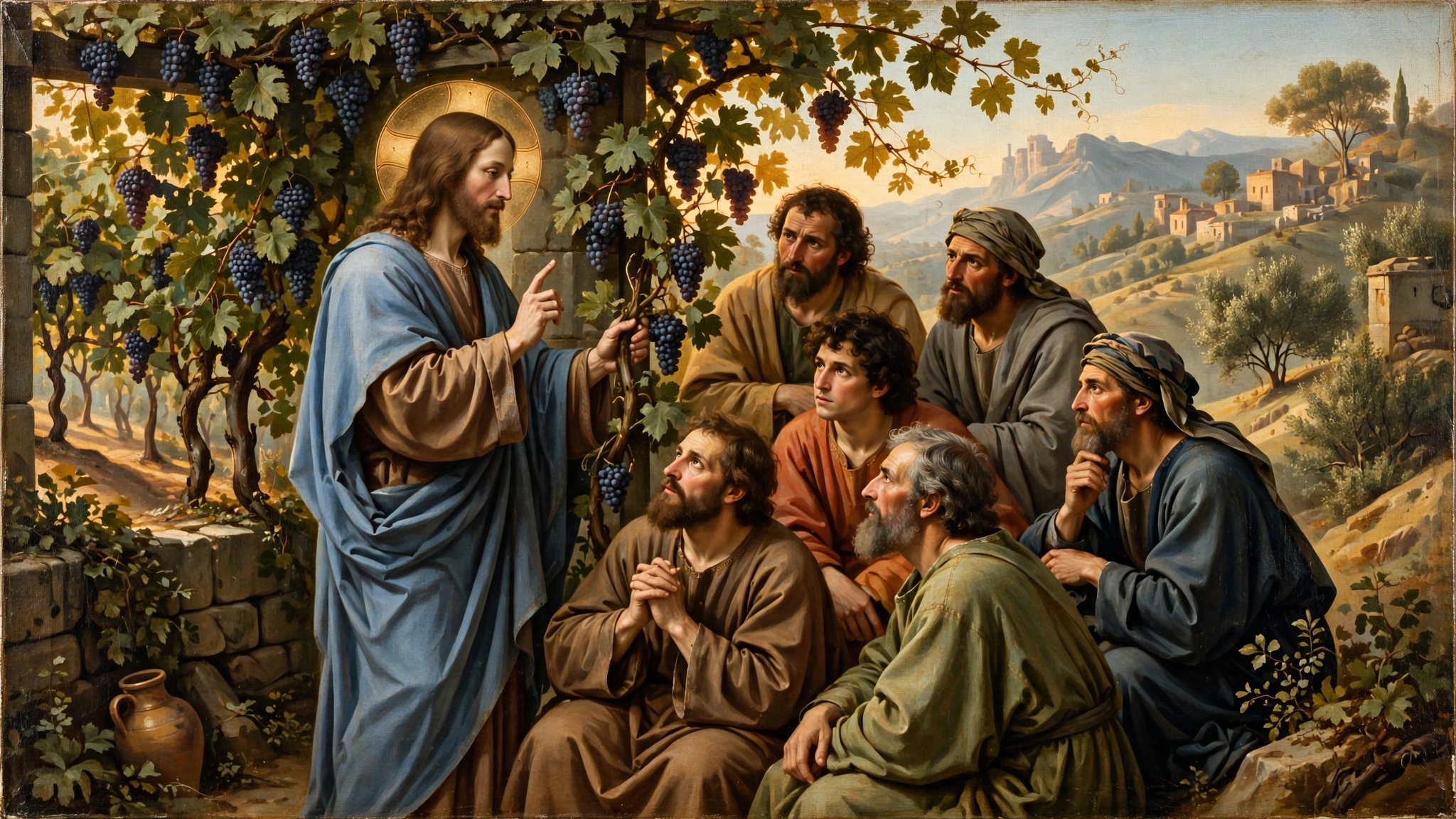
John 15 – Historical and Spiritual Context
John 15 takes place during the Upper Room Discourse, the final, intimate moments Jesus shared with His disciples before His arrest in the Garden of Gethsemane. As the shadow of the cross loomed, Jesus transitioned from teaching about His departure to emphasizing the necessity of a continued, vital union with Him. By utilizing the metaphor of the vine and the branches, Jesus grounded His followers in the reality that their spiritual vitality was not dependent on their own willpower, but on their proximity to His person. The historical setting is one of impending separation, yet the spiritual intent is to provide a blueprint for an eternal, unbreakable connection that would sustain the Church long after His ascension.
The overarching theme of this chapter is “abiding”—a deliberate, consistent dwelling within the love and authority of Christ. This is not merely a call to moral behavior, but an invitation to organic union. The author, the Apostle John, captures this moment to show that the Christian life is meant to be lived from the “inside out.” By exploring the relationship between the Vine (Jesus), the Vinedresser (the Father), and the branches (the believers), John highlights that fruitfulness is the natural byproduct of intimacy. The chapter serves as a profound reminder that while the world may be characterized by hostility and pruning, the believer’s security remains anchored in the life-giving sap of the True Vine.
Detailed Verse-by-Verse Commentary
Study of John 15:1
“I am the true vine, and my Father is the gardener.”
In the Old Testament, Israel was often depicted as a vine that failed to produce good fruit (Isaiah 5:1-7). By calling Himself the “true” vine, Jesus is declaring that He is the authentic source of life and the fulfillment of God’s covenantal purpose. The Greek word for “true” here is alēthinos, meaning real, genuine, or ultimate. While Israel was a shadow, Jesus is the substance. Furthermore, the mention of the Father as the “gardener” (or vinedresser, geōrgos) reminds us that our spiritual growth is under the careful, intentional, and sovereign management of God. He is not a distant deity, but an active participant in our lives, pruning away what is dead to ensure we flourish in what is eternal.
Study of John 15:5
“I am the vine; you are the branches. If you remain in me and I in you, you will bear much fruit; apart from me you can do nothing.”
This verse contains the heart of the chapter: the concept of “abiding.” The Greek word used for “remain” is menō, which implies a permanent, settled state of dwelling. It suggests that our relationship with Christ is not a sporadic encounter but a continuous residence. The theological implication is radical: our fruitfulness—our character, our witness, and our works—is not generated by our effort, but by the flow of Christ’s life through us. The sobering reality, “apart from me you can do nothing,” serves as a corrective to the pride of human self-sufficiency, reminding us that any “fruit” produced outside of this union lacks eternal value.
Study of John 15:13
“Greater love has no one than this: to lay down one’s life for one’s friends.”
This verse elevates the metaphor of the vine to the level of sacrificial action. Jesus is preparing His disciples for the ultimate act of love—His death on the cross. The Greek word for “love” used here is agapē, a selfless, sacrificial, and unconditional love that seeks the highest good of the other. By calling His followers “friends,” Jesus highlights the intimacy of the vine-branch relationship. He is not merely a distant master, but a friend who demonstrates the depth of His commitment through the surrender of His own life. This establishes the standard for our relationships: we are called to love others with the same sacrificial, life-giving intensity that He showed us.
Practical Application for Your Daily Life
To “abide” in a modern, fast-paced world, you must intentionally carve out space for silence and communion with Christ. This means starting your morning not with the noise of your phone, but with the “Word of the Vine.” Whether you are at work or managing a household, practice “breath prayers”—short, silent petitions that acknowledge your dependence on Him throughout the day. When you feel overwhelmed, frustrated, or tempted to rely on your own strength to “produce results,” stop and consciously invite the Vine to provide the energy for your next task. True fruitfulness at work or with family often looks like patience, kindness, and peace—qualities that can only be sustained when you are drawing from the deep reservoir of Christ’s presence.
Furthermore, embrace the “pruning” seasons of your life as acts of love from the Father. When a project fails, a relationship is tested, or a season of comfort is stripped away, do not view it as divine abandonment. Instead, recognize it as the Vinedresser’s hand removing the dead weight so that you can bear more fruit in the future. In your interactions with others, reflect the “greater love” of John 15 by choosing to serve those who are difficult to love. By laying down your need to be right, your pride, or your time for the sake of others, you are demonstrating that you are indeed a branch connected to the True Vine, allowing His life to flow through you into the lives of those around you.
Daily Prayer and Reflection
Guided Scriptural Prayer
Heavenly Father, thank You for grafting me into the life of Your Son, the True Vine. I confess that I often try to produce fruit in my own strength, forgetting that apart from You, I can do nothing. Please prune away the distractions and sins that hinder my growth, and help me to dwell intentionally in Your love throughout this day. May my life be a reflection of Your sacrificial love, bearing fruit that brings glory to Your name. Amen.
<hr />
<p style=”text-align: center; color: #64748b; font-size: 14px; font-style: italic;”>We hope this study guide on John 15 blessed your day.</p>