
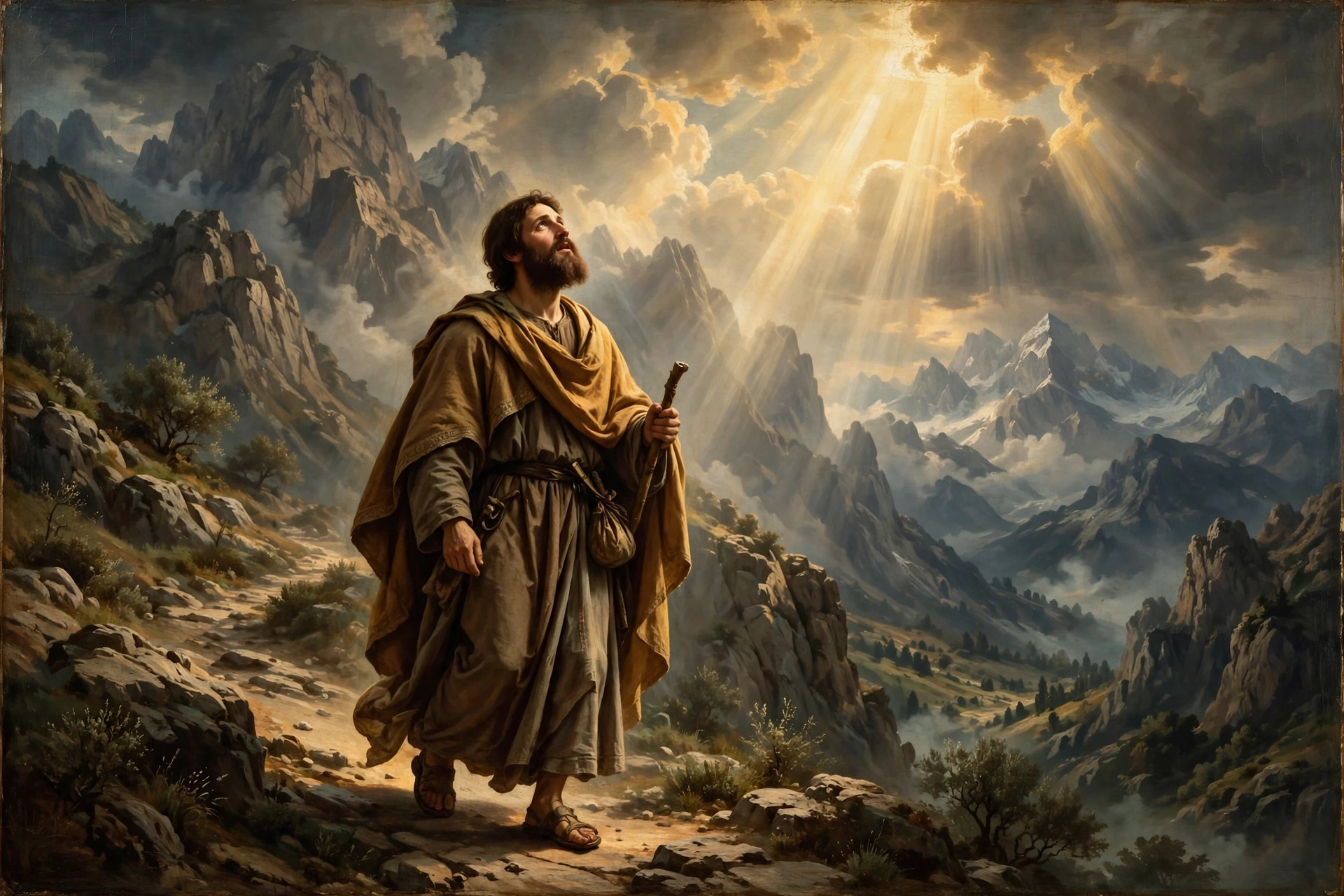
Psalm 121 – Historical and Spiritual Context
Psalm 121 is famously categorized as one of the “Songs of Ascents” (Psalms 120–134), a collection of hymns traditionally sung by Jewish pilgrims as they traveled upward toward Jerusalem for the three great annual festivals. The physical journey was arduous, filled with the dangers of rugged terrain, hidden bandits, and the blistering heat of the Judean wilderness. The Psalmist captures the vulnerability of these travelers, using the act of lifting one’s eyes to the hills as a metaphor for seeking help amidst a landscape that was both majestic and intimidating. By looking toward the hills, the pilgrim is forced to confront the source of their true security—not the high places themselves, but the Creator who stands above them.
The overarching spiritual theme of this Psalm is the absolute, unceasing sovereignty of God as the “Keeper” of His people. In a world of shifting circumstances and personal anxieties, the Psalmist anchors his faith in the immutable nature of Yahweh. The Hebrew word for “keep” or “keeper” (*shamar*) appears six times in these eight verses, emphasizing a protective, watchful guardianship that never slumbers. This is not merely a promise of physical safety, but a declaration of spiritual preservation. It serves as a timeless reminder that while our path through life may be steep and fraught with uncertainty, our stability is rooted entirely in the One who holds the heavens and the earth in His hands.
Detailed Verse-by-Verse Commentary
Study of Psalm 121:1
“I lift up my eyes to the hills. From where does my help come?”
This opening verse is a pivot point of perspective. In the ancient Near East, “high places” were often associated with pagan shrines or places of potential danger. By asking “from where does my help come?”, the Psalmist is rhetorically dismissing the idols of the hills and the physical fortifications of man. The Hebrew verb for “lift up” (*nasa*) implies a deliberate, conscious act of turning one’s focus away from the immediate environment. It is a spiritual discipline of detachment—refusing to be defined by the obstacles in front of us and choosing instead to orient our souls toward the transcendent God.
Study of Psalm 121:3
“He will not let your foot be moved; he who keeps you will not slumber.”
The imagery here is deeply personal. To “let your foot be moved” suggests the instability of a traveler on a rocky path; it is the threat of slipping, falling, or losing one’s way. The theological assurance is that God’s vigilance is active and constant. The Hebrew word for “slumber” (*num*) refers to a light, drowsy state. By stating that God “will not slumber,” the Psalmist contrasts the limitations of human guardians—who must eventually rest—with the infinite, tireless nature of the Almighty. Your stability is not maintained by your own grip, but by His firm hold upon you.
Study of Psalm 121:5
“The Lord is your keeper; the Lord is your shade on your right hand.”
This verse shifts the focus from God’s general oversight to His intimate proximity. In the scorching heat of the Middle Eastern sun, “shade” was a matter of life and death. By describing the Lord as shade on the “right hand,” the Psalmist invokes the image of a protector standing in the most advantageous position to defend or assist. In Hebrew, the Lord is identified as *Shomreka* (Your Keeper). This is a covenantal promise; it asserts that the Creator of the universe is not a distant deity, but a personal bodyguard who shields you from the “burning” trials of life.
Practical Application for Your Daily Life
Applying Psalm 121 in your daily life begins with a “re-calibration of vision.” When you face overwhelming pressure at work or conflict within your family, pause and ask yourself: “Where am I looking for my help?” Often, we look to our own resources, our bank accounts, or the opinions of others to provide the security we crave. Practice the discipline of the “upward gaze”—literally and metaphorically stopping your internal frantic activity to acknowledge that God is your current help. By consciously shifting your focus from the “hills” of your problems to the Creator of the hills, you replace the spirit of anxiety with a posture of quiet confidence.
Furthermore, lean into the comfort of God’s “unslumbering” nature when you feel exhausted by your responsibilities. As a parent, employee, or spouse, you may feel that the weight of the world rests on your shoulders, but Psalm 121 invites you to delegate your care to the ultimate Keeper. You can rest at night, knowing that while you sleep, God is actively managing the details of your life that you cannot control. Let this truth transform your prayer life: instead of praying only for outcomes, pray for the realization that you are being kept, protected, and guided by a God who never grows tired of watching over you.
Daily Prayer and Reflection
Guided Scriptural Prayer
Lord, today I lift my eyes from the looming challenges of my life and fix them firmly upon You, my true source of help. Thank You for being my constant Keeper, the One who guards my steps and provides shade from every trial I encounter. I release my need to control the outcome of my circumstances, finding deep rest in the truth that You never slumber or sleep. May I walk through this day with the confidence of one who is held securely in Your hands. Amen.
<hr />
<p style=”text-align: center; color: #64748b; font-size: 14px; font-style: italic;”>We hope this study guide on Psalm 121 blessed your day.</p>