

Welcome to this deep dive into the heart of the Gospel of John. As we journey through John 19, we witness the pinnacle of the Savior’s earthly mission, exploring the profound depths of His suffering, the fulfillment of ancient prophecy, and the glorious reality of the Atonement.
John 19 — Historical and Spiritual Context
John 19 provides the definitive eyewitness account of the Passion of Christ, written by the Apostle John, likely in the late first century (c. 90 AD) from Ephesus. It details the legal proceedings, the physical scourging, the crucifixion, and the burial of Jesus, serving as a solemn record for the early Church facing persecution and theological challenges regarding the humanity and divinity of Christ. You can read John 19 on Bible Gateway to ground yourself in the text before our study.
Theologically, this chapter is the focal point of human history, where the “Lamb of God” (John 1:29) fulfills His purpose to take away the sin of the world. For the modern believer, John 19 is not merely a historical account of ancient violence; it is a mirror reflecting the gravity of our own sin and the infinite, sacrificial love of a God who would endure such agony to secure our redemption and reconcile us to the Father.
Verse-by-Verse Commentary on John 19
John 19:5 — Meaning and Explanation
“Then came Jesus forth, wearing the crown of thorns, and the purple robe. And Pilate saith unto them, Behold the man!”
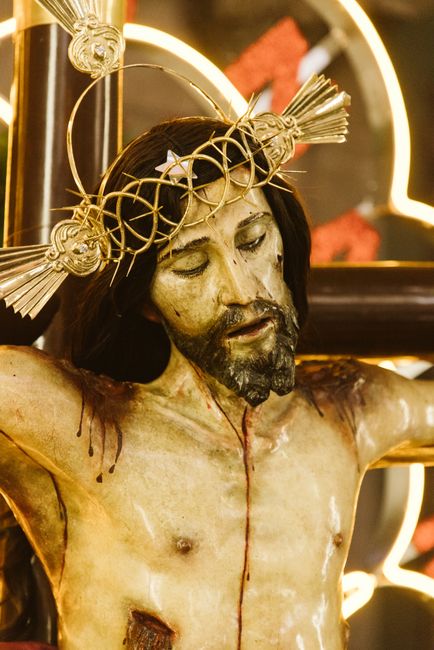
When Pilate presents Jesus, he uses the Greek phrase Ide ho anthropos, “Behold the man.” This is a moment of profound irony; the Roman governor intended to show a broken, humiliated victim to appease the mob, yet he unknowingly presented the perfect representative of humanity. The “crown of thorns” is a symbol of the curse of sin, which began in Eden (Genesis 3:18) and is now being borne by the Savior.
The Greek word for “thorns” is akanthinos, implying sharp, piercing agony. By wearing this, Jesus identifies with the suffering of a fallen world. As we look to Strong’s Concordance to analyze the term anthropos (G444), we see it refers to a human being, emphasizing that Jesus was truly man. He stands in our place, wearing the emblems of our failure, yet remaining the only sinless human to ever walk the earth.
John 19:19 — Meaning and Explanation
“And Pilate wrote a title, and put it on the cross. And the writing was, JESUS OF NAZARETH THE KING OF THE JEWS.”
Pilate’s inscription, known as the *Titulus Crucis*, was written in Hebrew, Greek, and Latin to ensure all in Jerusalem could read the charge against Jesus. Though intended as a mockery of the Jewish people and a warning to rebels, it served as a divine declaration of Christ’s true identity. He was not merely a political agitator; He was the King of Kings.
The “title” in Greek is titlos (G5102), a technical term for a placard identifying a criminal’s crime. In God’s sovereign providence, the very charge used to execute Him became His coronation proclamation. Matthew Henry notes that this title remained despite the protests of the religious leaders, signifying that Christ’s Kingship is an objective, unchangeable reality that no human authority can alter or erase.
John 19:30 — Meaning and Explanation
“When Jesus therefore had received the vinegar, he said, It is finished: and he bowed his head, and gave up the ghost.”
“It is finished” is perhaps the most powerful phrase in the New Testament. It is a translation of the single Greek word tetelestai (from teleo, G5055). This was a term used in the ancient world to signify that a debt had been paid in full, a task had been completed, or a sacrifice had been accepted. It was not a cry of defeat, but a shout of victory.
The spiritual significance is monumental: the debt of human sin, which we could never pay, was fully satisfied by Christ’s death. The veil of the temple was about to be torn, and the way to the Father was opened. When He “gave up the ghost,” it indicates that Jesus was not a victim of circumstance, but an active participant in His own death, voluntarily yielding His spirit to the Father to complete the work of salvation. You may find further insights into this momentous event at the Blue Letter Bible.

John 19:34 — Meaning and Explanation
“But one of the soldiers with a spear pierced his side, and forthwith came there out blood and water.”
The piercing of Jesus’ side serves as the final proof of His death, fulfilling the prophecy of Zechariah 12:10. The water and blood have been interpreted by theologians throughout history as symbols of the two sacraments: Baptism and the Lord’s Supper. More importantly, it confirms the physical reality of His humanity; the Savior truly died, and His heart truly stopped.
The word “pierced” in Greek is nysso (G3572), meaning to prick or stab sharply. This act of violence, intended to ensure death, actually confirms that the sacrifice was total. For the believer, this is a reminder that there is no part of our suffering or our sin that Christ has not touched. He was wounded for our transgressions, and the flow of blood and water represents the cleansing and life-giving power of His sacrifice.
How to Apply John 19 in Your Daily Life
Applying the lessons of John 19 requires us to move beyond intellectual assent and into a life of surrendered devotion. In your family life, consider the “It is finished” reality when you struggle with perfectionism or the weight of past regrets. If Christ has paid the debt in full, you are free from the need to earn your standing before God. Extend that same grace to your spouse or children, letting go of long-held grudges because the debt has already been settled at the Cross.
In your professional life, remember that you serve a King who was mocked and humiliated yet remained faithful to His mission. When you face workplace conflict, unfair criticism, or the temptation to compromise your integrity, look to the example of Jesus before Pilate. He did not defend His ego, but He stood firm in the truth. Your ultimate allegiance is to the King of the Jews, and your work is a reflection of that royal service.
A Prayer Based on John 19
Guided Scriptural Prayer
Heavenly Father, I stand in awe before the cross of Your Son, Jesus Christ, who endured the agony of the thorns and the weight of the spear for my sake. Thank You for the glorious truth that because of His sacrifice, my sins are washed away and my debt is paid in full. Help me to live each day in the freedom of His finished work, never forgetting the price that was paid for my soul. May the crown of thorns remind me to keep my heart humble, and may the blood and water remind me of the life I have in Him. In the name of the King of Kings, Jesus Christ, I pray, Amen.
Frequently Asked Questions About John 19
What is the main message of John 19?
The main message of John 19 is the completion of Christ’s redemptive mission through His voluntary death. It emphasizes that Jesus is the sovereign King who fulfills Old Testament prophecy, even while undergoing the humiliation of the cross. The chapter demonstrates that His death was not a failure but a triumph, as He perfectly satisfies the requirements of justice to provide atonement for humanity. Every detail—from the crown of thorns to the piercing of His side—serves to validate His identity as the Lamb of God who takes away the sin of the world.
Why was Jesus crucified according to John 19?
According to John 19, Jesus was crucified because of a confluence of religious jealousy, political pressure, and divine necessity. The religious leaders demanded His death because He claimed to be the Son of God, threatening their authority. Pilate, fearing a riot and his own standing with Caesar, succumbed to the crowd’s demands. However, the spiritual reality, as John presents it, is that Jesus laid down His life voluntarily to fulfill the Father’s plan of salvation, ensuring that the Scriptures regarding the Messiah would be fully accomplished.
What does “It is finished” mean in John 19:30?
“It is finished” (Greek: tetelestai) is a declaration that the work of salvation is complete. In the first century, this term was used by merchants to signify that a debt had been paid in full. By using this word, Jesus announced that the entire legal and moral obligation of human sin had been met by His sacrifice. No further payment, ritual, or human effort is required to be reconciled to God; the work of atonement is fully accomplished, and the barrier between God and man has been permanently removed through His death.
May the peace of the Lord, who walked the path of the cross for you, abide in your heart as you reflect on these sacred truths.