
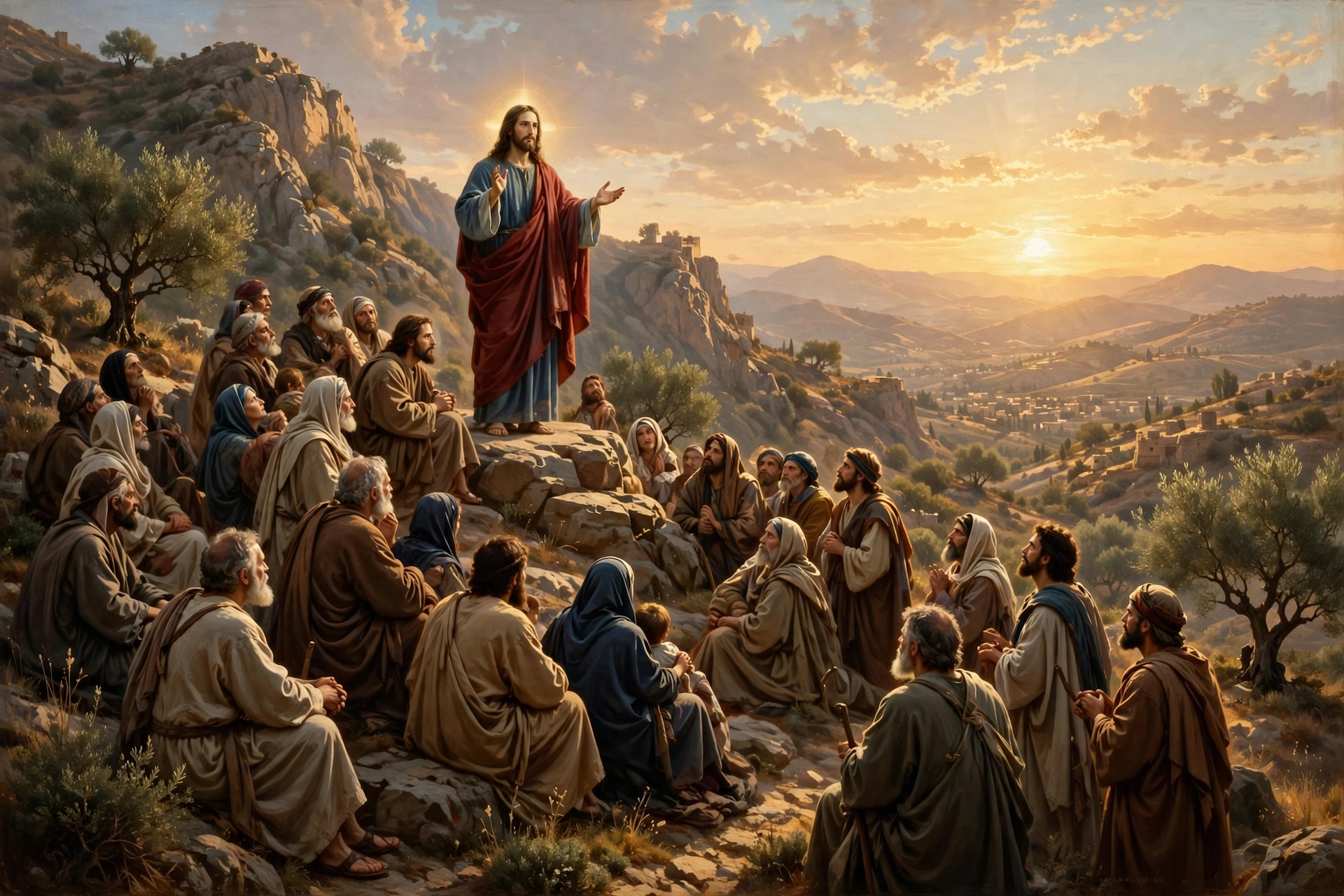
Matthew 5 – Historical and Spiritual Context
Matthew 5 serves as the majestic opening to the Sermon on the Mount, the foundational manifesto of the Kingdom of Heaven. Historically, Matthew wrote to a predominantly Jewish audience, presenting Jesus as the long-awaited Messiah who fulfills the Law and the Prophets. By situating Jesus on a mountainside, Matthew draws a deliberate parallel to Moses receiving the Law on Mount Sinai. However, while Moses brought the Law written on tablets of stone, Jesus brings a new, internal law written upon the heart, shifting the focus from mere outward observance to the radical transformation of the human spirit.
The spiritual theme of this chapter is the “upside-down” nature of God’s Kingdom. In a world obsessed with power, prestige, and self-preservation, Jesus introduces a counter-cultural reality where the poor in spirit are blessed, the meek inherit the earth, and the peacemakers are called children of God. This chapter is not merely a list of ethical demands; it is an invitation to participate in the divine nature. It challenges the believer to move beyond the letter of the law into the spirit of love, calling us to be the preservative salt and the illuminating light in a world that has lost its savor and its way.
Detailed Verse-by-Verse Commentary
Study of Matthew 5:3
**”Blessed are the poor in spirit, for theirs is the kingdom of heaven.”**
The term “blessed” (*makarios* in Greek) suggests a deep, unshakable joy that is independent of outward circumstances. To be “poor in spirit” is not a call to financial poverty, but to a profound spiritual bankruptcy. It is the humble recognition that we have nothing of value to offer God in exchange for our salvation. In the original Greek, the word for poor (*ptochos*) describes one who is a beggar, completely dependent on the mercy of others. Spiritually, this is the starting point of the Christian life: acknowledging that we are utterly helpless without the grace of God. When we empty ourselves of our pride and self-sufficiency, we create the necessary space for the Kingdom of Heaven to take root within us.
Study of Matthew 5:9
**”Blessed are the peacemakers, for they shall be called sons of God.”**
The Greek word for peacemaker, *eirenopoios*, implies more than just the absence of conflict; it signifies an active pursuit of reconciliation. In a biblical sense, a peacemaker is one who works to bring others into a right relationship with God and with one another. To be called “sons of God” reflects the character of the Father, who sent His own Son to make peace through the blood of the cross. This verse challenges us to be agents of restoration in a fractured world. It is a high calling, as it requires us to lay down our own rights and ego to bridge the gap between people, reflecting the sacrificial love of Christ in our daily interactions.
Study of Matthew 5:14
**”You are the light of the world. A city set on a hill cannot be hidden.”**
Jesus uses the metaphor of light (*phos*) to describe the visible impact of a life surrendered to Him. In the ancient world, a city on a hill was a beacon for travelers, impossible to miss. By declaring that we *are* the light, Jesus is stating an identity, not just a command. We do not generate this light ourselves; we reflect the glory of the True Light, Jesus Christ. This verse reminds us that the Christian life is meant to be public and influential. If our faith is truly vibrant, it will naturally pierce the darkness of our culture. We are called to live with such integrity and grace that those around us are drawn to the source of our illumination.
Practical Application for Your Daily Life
Applying the Sermon on the Mount begins with an intentional shift in your daily posture. In your family and workplace, practice the “poor in spirit” principle by letting go of the need to be right or the desire to defend your ego. When conflict arises, be the first to extend the hand of reconciliation, embodying the role of a peacemaker. This might look like choosing a gentle response over a sharp retort, or listening to a colleague with empathy instead of judgment. By lowering your own defenses, you allow the light of Christ to shine through your interactions, turning potentially volatile situations into opportunities for grace to be displayed.
In your spiritual walk, prioritize time in the “secret place” to ensure your inner life matches your outward witness. Being “salt and light” is not about performative religion, but about the overflow of a heart that is being refined by the Holy Spirit. Identify one area of your life where you have been “hiding your light”—perhaps through fear or conformity—and ask God for the courage to live authentically. Whether it is through acts of service, honest conversations, or simply maintaining a joyful spirit in a stressful environment, let your daily choices be a deliberate reflection of the Kingdom values Jesus taught.
Daily Prayer and Reflection
Guided Scriptural Prayer
Heavenly Father, thank You for the radical, life-giving truth of Your Word. Help me to remain poor in spirit today, constantly aware of my need for Your grace and guidance. Grant me the courage to be a peacemaker in my home and workplace, reflecting Your love to those who are lost or hurting. Let my life be a clear, steady light that points others toward Your Kingdom and away from the darkness of this world. May my thoughts, words, and actions today be a pleasing sacrifice to You. Amen.
<hr />
<p style=”text-align: center; color: #64748b; font-size: 14px; font-style: italic;”>We hope this study guide on Matthew 5 blessed your day.</p>