

The Architecture of Faith: A Biblical Exploration
Faith is the bedrock upon which the entire structure of the Judeo-Christian worldview rests. In the Old Testament, the Hebrew word emunah carries the weight of firmness, steadfastness, and reliability. It is not merely a mental assent to a proposition but a posture of total reliance upon the character of Yahweh. From the patriarch Abraham, who was “counted righteous” because he trusted God’s promise against all physical evidence, to the prophets who maintained hope in the face of national exile, faith was the sustaining force of the covenant people. It was an active, rugged trust that defined one’s identity in relation to the Creator.
In the New Testament, the Greek term pistis shifts the focus toward the person of Jesus Christ. Faith becomes the instrument by which the believer is united with the Savior. It is the bridge between human finitude and divine infinity. Modern Christians often struggle with faith because we have intellectualized it, mistaking “faith” for “belief in a set of doctrines.” While doctrine is vital, biblical faith is inherently relational and experiential—a life lived in the tension between the “already” of God’s kingdom and the “not yet” of our current suffering. In a culture saturated by skepticism and an obsession with empirical proof, the call to walk by faith rather than by sight is more counter-cultural—and more necessary—than ever before.
Contextual Scripture Analysis
Now faith is the substance of things hoped for, the evidence of things not seen. (Hebrews 11:1)
The Epistle to the Hebrews was written to a community of Jewish Christians who were tempted to abandon their faith in Jesus and return to the rituals of the Mosaic Law due to intense persecution. The author provides this classic definition at the beginning of the “Hall of Faith” chapter to anchor his readers. He argues that faith is not a flight from reality, but a deeper engagement with a higher reality—the reality of God’s sovereignty, which is unseen but more permanent than the physical world they were currently experiencing.
The word “substance” (Greek hupostasis) is a legal term, referring to a title deed or a foundation. It suggests that faith gives “body” or “weight” to our hopes; it makes them as real as the ground we stand on. The word “evidence” (elenchos) implies a conviction or a proof that settles a case. Together, these terms transform faith from a vague feeling into a legal and spiritual certainty. Faith acts as the lens that brings the invisible promises of God into sharp, unavoidable focus, proving them to be true even when the eyes of the flesh see only shadows.
The lesson here is that faith is not an absence of logic, but the presence of a deeper logic. It is the internal assurance that God’s Word is the final authority on reality. When we feel that our prayers are falling on deaf ears or our circumstances appear hopeless, this verse reminds us that we possess the “title deed” to God’s promises. We do not hope because we are optimistic; we hope because we have the evidence of God’s past faithfulness and His immutable character.
For we walk by faith, not by sight. (2 Corinthians 5:7)
The Apostle Paul wrote this letter to the church in Corinth, a community fraught with internal divisions and external pressures. He is contrasting the transient nature of our physical bodies—which he describes as “earthly houses”—with the eternal dwelling God has prepared for us. Paul is urging the Corinthians not to lose heart in their tribulations. He understands that the human tendency is to judge the success of the Christian life by physical health, financial stability, or social approval. He is correcting this error by establishing a new primary mode of operation for the believer.
The metaphor of “walking” is significant here. Walking is a daily, rhythmic, and continuous action. It requires a destination and a steady pace. Paul sets “faith” in opposition to “sight”—the sensory data that bombards us daily. Sight is reactive; it responds to the immediate. Faith is proactive; it responds to the eternal. To “walk by faith” is to navigate the terrain of our lives using the map provided by the Holy Spirit rather than the shifting sands of our immediate circumstances.
The spiritual lesson is one of orientation. When we focus primarily on what we see (our bank accounts, our illnesses, our failures), we are governed by fear and anxiety. When we govern our lives by what we know of God’s nature, we find a steady equilibrium. This verse calls us to practice a “holy blindness” toward the threats of the world so that we may have “perfect sight” toward the promises of God. It is a call to radical trust in the middle of our daily commute, our workplaces, and our homes.
For by grace are ye saved through faith; and that not of yourselves: it is the gift of God. (Ephesians 2:8)
Paul’s letter to the Ephesians is a grand theological treatise on the nature of the Church and the mystery of the Gospel. In this passage, he is dismantling the notion of human merit. The Ephesians, like many of us, were prone to thinking that their standing with God was based on their moral performance or religious heritage. Paul shatters this by declaring that salvation is a package deal: grace is the source, and faith is the conduit.
The key phrase here is “not of yourselves.” Even the faith we exercise is described as a “gift of God.” This is a profoundly humbling realization. It means that we do not have to manufacture faith through sheer willpower or positive thinking. We are not “saving ourselves” by having enough faith; rather, we are participating in a relationship that God initiated. The faith we have is a divine spark, placed within us by the Holy Spirit, allowing us to receive what we could never earn.
The spiritual takeaway is the liberation from the “performance trap.” Many believers live in a state of exhaustion, trying to “muster up” enough faith to get God to move. This verse tells us that faith is not a currency we use to bribe God; it is a capacity he grants us to receive His grace. When you feel your faith is weak, stop looking at your own ability to believe and start looking at the God who gave you the gift of faith in the first place. He is both the author and the finisher of that faith.
Summary Takeaways Table
| Verse (KJV) | Core Spiritual Message | Actionable Lesson |
|---|---|---|
| Hebrews 11:1 | Faith is the reality of the unseen. | Document God’s past faithfulness to anchor your current hopes. |
| 2 Corinthians 5:7 | God’s truth overrides sensory data. | Filter your daily reactions through Scripture, not current emotions. |
| Ephesians 2:8 | Faith is a gift, not an achievement. | Pray for faith when you feel weak; stop trying to “perform” belief. |
Practical Devotional Application
The Morning “Anchor” Routine
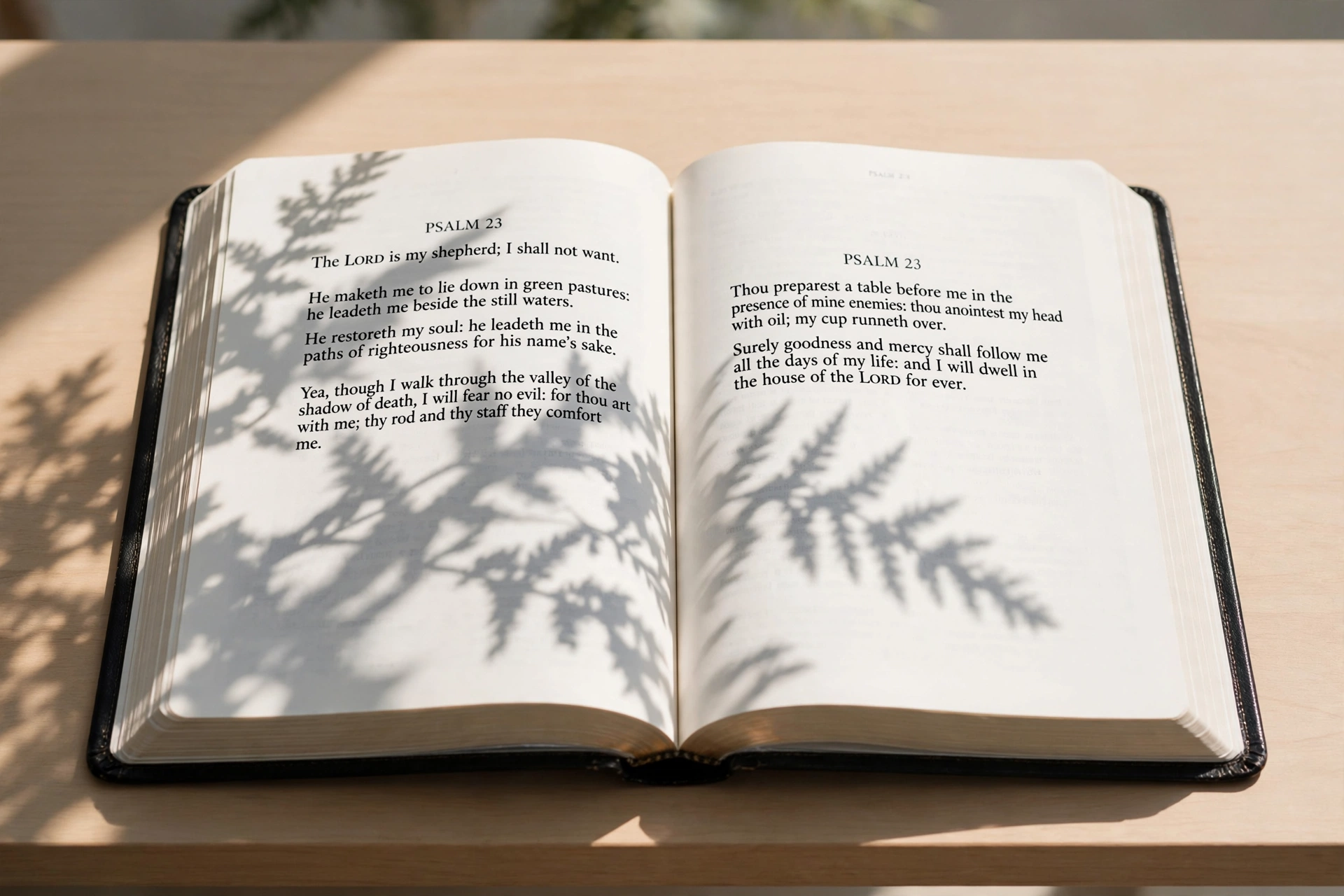
Begin your day by intentionally setting your internal compass. Before checking your phone or email, read one short Psalm or a passage from the Gospels. As you read, ask yourself, “What does this tell me about who God is?” By anchoring your mind in His character before the world demands your attention, you are choosing to walk by faith. This creates a “spiritual buffer” that protects you from the knee-jerk reactions of anxiety or anger throughout the day.
The “Evidence” Journaling Method
Faith often falters because we have a short memory. Keep a small journal where you record “Evidence of God.” When you see a prayer answered, a moment of unexpected peace, or a provision you didn’t see coming, write it down. On days when your faith feels thin, read through these entries. This is your personal “Hall of Faith,” a tangible reminder that the God who acted in the past is the same God who is with you in the present.
Practicing “Pause and Pivot”
When you encounter a difficult circumstance—a bad report, a conflict, or a sudden loss—practice the “Pause and Pivot.” Pause to acknowledge the fear or the reality of the situation, but then pivot to a specific verse of promise. For example, if you are facing a financial crisis, don’t just stare at the bank statement; recite Philippians 4:19. By verbalizing the promise, you are “walking” by faith, using your voice to align your reality with God’s kingdom rather than your current stress.
Empathic Daily Prayer
Guided Scriptural Prayer
Heavenly Father, I come before You today acknowledging that my faith is often as fragile as the wind. There are days when the shadows of this world feel far more substantial than Your promises, and I find myself stumbling in the dark of my own understanding. Please forgive me for relying on my sight rather than Your truth. Grant me, I pray, the grace to see beyond the immediate, to trust in Your sovereign hand even when the path ahead is shrouded in mystery. Strengthen the root of faith within me, not by my own striving, but by the gentle, persistent work of Your Holy Spirit.
Lord, when the storms of life arise and my heart is tempted to doubt, be my steady anchor. Remind me that my standing with You is not a result of my perfect performance, but a gift of Your boundless grace. Give me the courage to walk forward, step by step, knowing that You are the author and the finisher of my journey. May my life be a living testimony to the fact that You are faithful, You are present, and You are more than enough for every challenge I face. In the name of Jesus, my Savior and my hope, Amen.
Frequently Asked Questions
Is it possible to have “too little” faith, and does that hinder God’s work in my life?
The Bible speaks of “little faith” not as a measure of our failure, but as a description of our current stage of growth. Jesus often gently rebuked the disciples for their “little faith” when they were afraid of the storm, but He never abandoned them because of it. God’s power is not contingent upon the size of your faith, but upon the object of your faith—which is Christ. You do not need a mountain of faith to move a mountain; you only need a mustard seed of faith in a God who is capable of moving anything. When you feel your faith is small, lean into the fact that God is great.
How can I distinguish between “blind faith” and “biblical faith”?
Biblical faith is never blind; it is sighted. It is based on the revealed character of God, His historical actions recorded in Scripture, and the resurrection of Jesus Christ. “Blind faith” suggests a leap into the dark, hoping against hope that something might be true. Biblical faith is a leap into the light, resting on the evidence of what God has already done. If your faith is based on a whim or an emotional desire, it may be unstable. If your faith is based on the promises of God found in His Word, it is built on a rock that cannot be moved by changing circumstances.
What should I do if I feel like I am losing my faith during a long season of suffering?
It is common for the deepest seasons of faith to feel like a “dark night of the soul.” Suffering has a way of stripping away our superficial beliefs, leaving us with the raw core of what we truly trust. If you are struggling, do not retreat from God in shame. Bring your doubts to Him. Read the Psalms, where the writers frequently lament their circumstances, cry out for God’s presence, and struggle with the silence of heaven. Faith is not the absence of doubt; it is the act of bringing your doubt into the presence of God. Keep showing up to prayer, keep reading the Word, and allow God to sustain you even when you feel you cannot sustain yourself.