
The Biblical Perspective on Death: A Journey from Shadow to Substance
The theme of death permeates the biblical narrative, beginning with the warning in the Garden of Eden and culminating in the glorious vision of a city where “there shall be no more death” in the book of Revelation. In the Old Testament, death is often viewed through the lens of Sheol—a place of quietude and separation from the vibrant, covenantal worship of God on earth. It is frequently associated with the consequence of sin and the fragility of human life, as seen in the lamentations of Job and the reflective wisdom of Ecclesiastes. Yet, even in the Old Testament, there is an underlying hope, a yearning for redemption that extends beyond the grave, as evidenced by the Psalmist’s confidence that God would not leave his soul in the pit.
The New Testament shifts the paradigm entirely. Through the death and resurrection of Jesus Christ, the sting of death is removed. For the Christian, death is no longer a terminal ending or an abyss of uncertainty, but a “falling asleep” in Christ. It is a transition—a passage from the temporal, fallen world into the immediate presence of the Savior. This theological pivot is essential because modern Christians live in a culture that treats death as a taboo, a medical failure, or an absolute extinction. We struggle with the visceral pain of loss because we often lose sight of the eschatological horizon. We need this biblical encouragement not to bypass our grief, but to anchor our hope in the reality that Christ has conquered the last enemy, transforming the finality of the grave into the doorway of eternal life.
Contextual Scripture Analysis

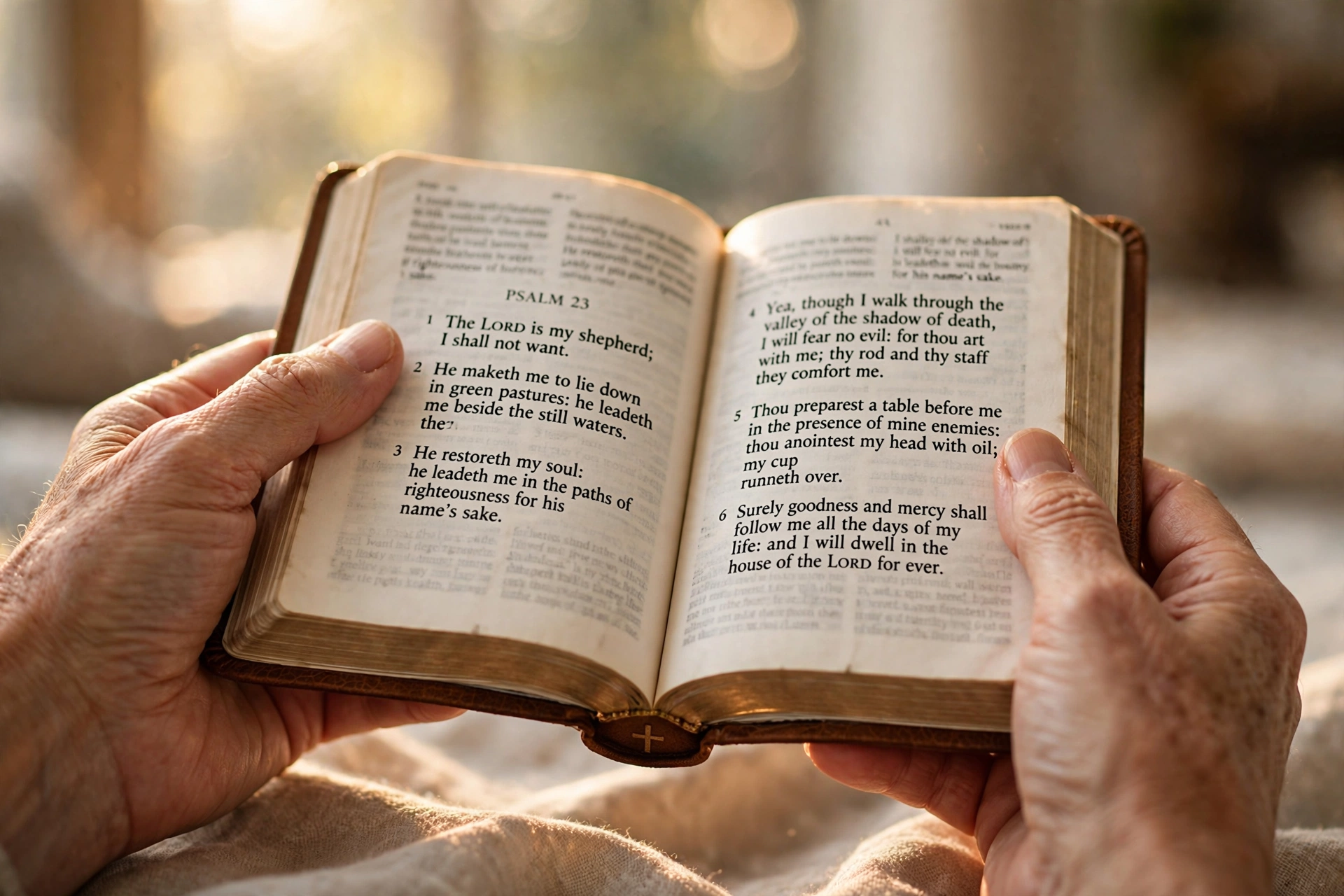
1. Psalm 23:4
“Yea, though I walk through the valley of the shadow of death, I will fear no evil: for thou art with me; thy rod and thy staff they comfort me.”
Psalm 23 is traditionally attributed to David during a time of great peril. As a shepherd, David understood the treacherous topography of the Judean wilderness, where deep wadis (valleys) provided both hiding places for predators and dangerous paths for the flock. David uses this imagery to describe his own existential crisis, likely written during the rebellion of his son Absalom or the wilderness wanderings when his life was constantly threatened. The context is one of extreme vulnerability, where the shepherd’s presence is the only buffer between the sheep and destruction.
The phrase “valley of the shadow of death” is a powerful metaphor. The word “shadow” implies that the darkness is imposing, but a shadow cannot exist without a light source. Furthermore, a shadow has no substance; it can terrify, but it cannot consume. By describing death as a “shadow,” David acknowledges its frightful appearance while simultaneously stripping it of its power to harm the one who walks under the Shepherd’s protection. The “rod and staff” represent the Shepherd’s authority and guidance—tools used to defend against enemies and gently correct the wayward sheep.
The spiritual lesson here is that the Christian’s confidence in the face of death is not derived from their own courage, but from the Shepherd’s presence. We do not stop in the valley; we walk through it. The presence of God does not guarantee an escape from the experience of death, but it guarantees that we will not be alone in it. Fear is neutralized not by the absence of danger, but by the overwhelming reality of God’s companionship.
2. 1 Corinthians 15:55-57
“O death, where is thy sting? O grave, where is thy victory? The sting of death is sin; and the strength of sin is the law. But thanks be to God, which giveth us the victory through our Lord Jesus Christ.”
Paul the Apostle wrote this letter to a church in Corinth that was struggling with profound confusion regarding the nature of the resurrection. Some members were denying the bodily resurrection of the dead. In chapter 15, Paul constructs a rigorous theological defense, arguing that if Christ did not rise, the faith is vain. This passage serves as the triumphant conclusion to his argument, where he looks past the temporal reality of the grave to the eschatological victory achieved at the cross.
Paul personifies death and the grave as defeated antagonists. The “sting” of death is identified as sin—it is the poisonous venom of transgression that gives death its lethal power. The “strength of sin” is the law, which exposes our inability to meet God’s standard of holiness. By linking these, Paul explains why death is so terrifying: it is the legal execution of a guilty verdict. However, through the resurrection, the legal requirement is satisfied, the power of sin is broken, and the “sting” is extracted.
The lesson for the believer is that death has been disarmed. Because Christ has paid the debt of the law, the “sting” (the judgment of sin) has been removed. We can now look at death not as a legal executioner, but as a defeated foe. The victory is not something we earn; it is a gift (“thanks be to God, which giveth us the victory”). Our hope is anchored in the objective historical fact of Christ’s resurrection, which guarantees our own.
3. Philippians 1:21
“For to me to live is Christ, and to die is gain.”
Paul wrote the epistle to the Philippians from a Roman prison, facing the very real possibility of execution. He was caught in a “strait betwixt two”—the desire to remain and serve the church versus the desire to be with Christ. This is not the writing of a man who is detached from life, but one who has so thoroughly integrated his identity with Christ that the boundaries between his existence and his Savior’s have become porous.
The key to this verse is the equation: “To live = Christ.” Paul’s life was not defined by his career, his status, or his personal comfort, but by the mission and person of Jesus. Consequently, if his life is Christ, then death is not the loss of life, but the gain of an even more intimate, unhindered communion with Him. The word “gain” (Greek: kerdos) implies a commercial profit or an increase in value, suggesting that death is an upgrade in the quality of his relationship with his Lord.
The spiritual lesson is a radical reorientation of our values. Most people view death as a “loss”—a loss of time, relationships, and sensory experiences. Paul, however, views life from the perspective of eternity. If our primary treasure is Christ, then anything that brings us closer to Him is, by definition, a gain. This perspective empowers the believer to live courageously and die peacefully, knowing that the best is yet to come.
Summary Takeaways Table
| Verse (KJV) | Core Spiritual Message | Actionable Lesson |
|---|---|---|
| Psalm 23:4 | God’s presence removes the fear of death. | Practice “presence-awareness” when facing loss. |
| 1 Cor 15:55-57 | Sin is defeated; death has no legal claim. | Rest in the finished work of the Cross. |
| Phil 1:21 | Death is an upgrade to deeper communion. | Prioritize Christ as your primary treasure. |
Practical Devotional Application
Cultivating an Eternal Perspective
To implement these truths, start your day by intentionally shifting your focus from the temporal to the eternal. In your morning prayer, acknowledge that your life belongs to Christ. When you face small frustrations or anxieties, label them as “temporal” and remind yourself that they do not define your ultimate reality. By practicing this “eternal perspective” in the small things, you build the spiritual muscle required to face the “big things,” such as the death of a loved one or your own mortality.
The Practice of Lament and Hope
Do not suppress your grief; rather, bring it into the light of Scripture. When you encounter death, follow the pattern of the Psalms: express your sorrow honestly to God, but then anchor your soul in His promises. Write down verses like 1 Corinthians 15:55 in a journal and read them aloud. When you feel overwhelmed, create a “remembrance list” of God’s faithfulness in your life, using it as proof that the Shepherd who has been with you through the past will surely be with you in the future.
Living with “Open Hands”
Practice the principle of “open hands” regarding your earthly life. Every evening, reflect on the day and consciously “release” your control to God. Pray, “Lord, my life is Yours. If I wake tomorrow, I will serve You; if I pass into eternity, I will be with You.” This daily surrender acts as a spiritual discipline that reduces the grip of fear. It transforms the concept of death from a terrifying intrusion into a natural transition, allowing you to live your days with greater freedom, joy, and purpose.
Empathic Daily Prayer
Guided Scriptural Prayer
Heavenly Father, You are the Alpha and the Omega, the Lord of both the living and the dead. I come before You today with a heart that often trembles at the fragility of life and the shadow of the unknown. Grant me the grace to see my life through the lens of eternity, knowing that because Jesus lives, I shall live also. When the weight of grief or the fear of the end presses upon me, please remind me that I am never walking through the valley alone, for You are my Shepherd, and Your presence is my constant comfort.
Lord, help me to live in such a way that Christ is my everything, so that I may find peace in the promise that to be absent from the body is to be present with You. Strip away the fear of the grave and replace it with the hope of the resurrection. May my life be a testimony to the victory of the Cross, and may my heart remain anchored in the truth that death is not a finality, but the beginning of an eternal, glorious union with my Savior. In Jesus’ name, I pray. Amen.
Frequently Asked Questions
If death is a consequence of sin, why do even the most faithful Christians still have to die?
The physical death of the believer is not a punishment for sin in a judicial sense, as the penalty of sin was fully paid by Christ on the cross. Instead, it is an inherent part of the current “groaning” of creation described in Romans 8. We live in a fallen world where our physical bodies are still subject to the consequences of the Fall. Death, for the believer, serves as the final sanctification—the complete shedding of our “mortal coil” so that we may be clothed in the incorruptible, glorified bodies promised in the resurrection. It is the final transition out of a broken environment into the perfect presence of the Creator.
Does the Bible suggest we will recognize our loved ones in the afterlife?
While the Bible does not provide a detailed manual on the logistics of heaven, it strongly implies the continuity of personal identity. In the Transfiguration, the disciples recognized Moses and Elijah, despite them having been dead for centuries. Furthermore, the resurrection of Jesus—which serves as the “firstfruits” of our own—involved a recognizable, physical body. The communion of the saints in the New Jerusalem implies social interaction and shared memory. Our relationships in Christ are eternal; since they are rooted in Him, they will not be erased, but rather perfected and purified in the life to come.
What does the Bible mean when it says death is “the last enemy” to be destroyed?
In 1 Corinthians 15:26, Paul identifies death as the final enemy to be defeated by Christ. This means that death is an intruder in God’s good creation—it was never part of the original design for humanity. By calling it an “enemy,” the Bible validates our human intuition that death is “wrong” and unnatural. Its destruction occurs in stages: first, through the resurrection of Christ, its legal power was broken; and finally, at the end of the age, its physical reality will be abolished entirely. The destruction of death signifies the complete restoration of God’s kingdom, where mortality is swallowed up by life.