

What Does the Bible Say About Faith?
The Bible defines faith as the substance of things hoped for and the evidence of things not seen, serving as the essential foundation for a believer’s relationship with God. Scripture consistently teaches that faith is not merely an intellectual assent to facts, but a total, transformative reliance upon the character and promises of the Creator.
In the Old Testament, the Hebrew word for faith is ’emunah (Strong’s H530), which carries the connotation of steadfastness, integrity, and fidelity—the same word used to describe the stability of Aaron and Hur holding up Moses’ hands. In the New Testament, the Greek word pistis (Strong’s G4102) denotes a firm persuasion and a conviction based upon hearing the Word of God. You can explore a deeper word study of these terms at the Blue Letter Bible. Without this active, living faith, it is impossible to please God, as it acts as the conduit through which His grace is apprehended by the human heart.
For the modern Christian, understanding faith is critical because we live in an age of skepticism that demands empirical proof for every reality. However, the biblical model of faith invites us to step beyond the limitations of the senses and ground our identity in the unchanging nature of the Almighty. When we anchor ourselves in the promises of Scripture, faith becomes the anchor for the soul, providing stability amidst the shifting tides of cultural trends and personal adversity.
Most Powerful Bible Verses About Faith (KJV)
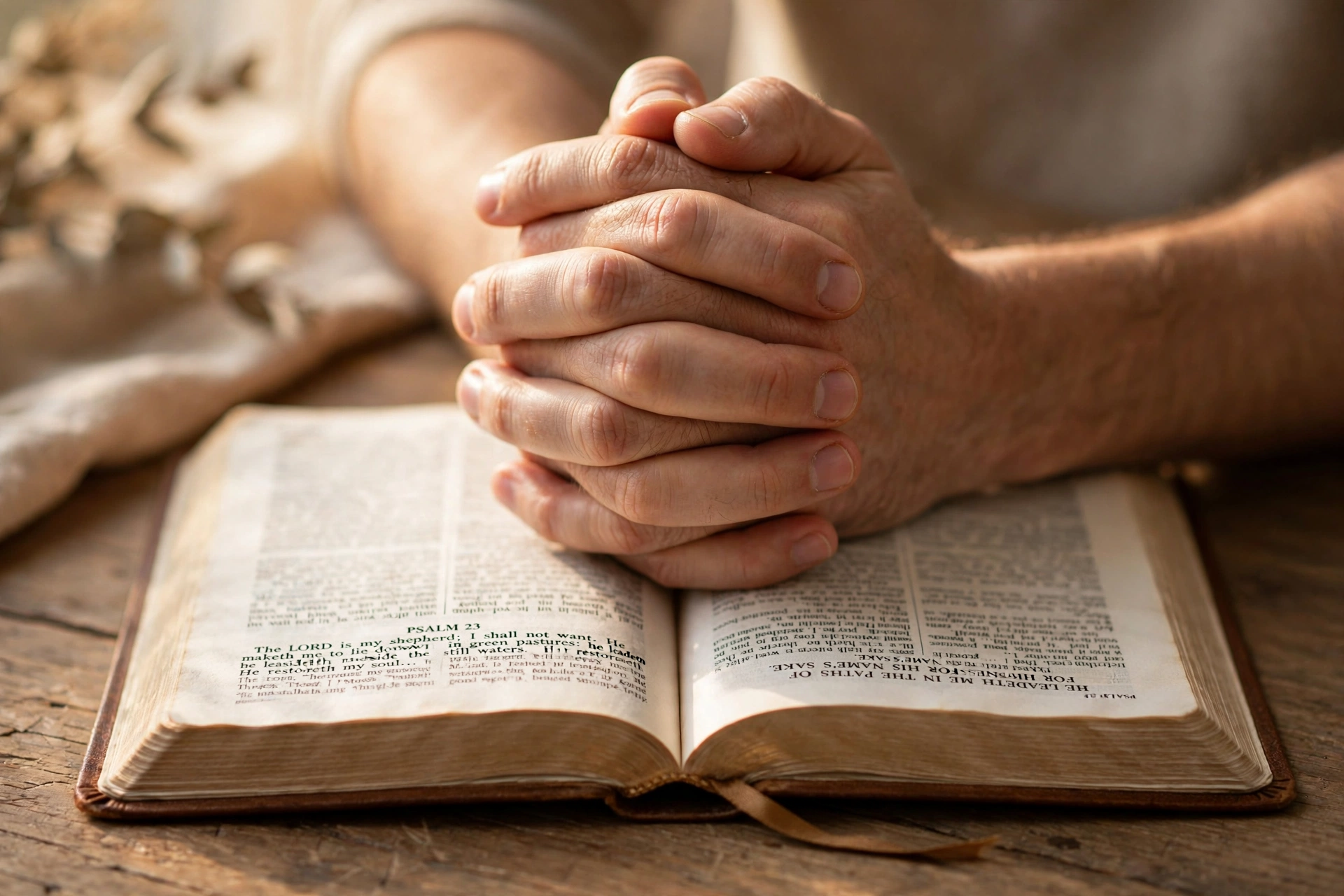
Now faith is the substance of things hoped for, the evidence of things not seen. Hebrews 11:1 (KJV)
The author of Hebrews writes to a group of Jewish Christians under intense persecution, urging them not to shrink back into the safety of their old traditions. He defines faith as hupostasis (Strong’s G5287), which can mean “foundation” or “assurance.” It is the spiritual reality that gives “substance” to our future hopes.
In the original Greek, Strong’s Concordance highlights hupostasis as a “setting under” or “support.” This implies that faith is not a wishful thought, but a structural reality that holds us up. The word elenchos (evidence) suggests a conviction so strong that it produces a internal proof, even when external circumstances remain unchanged.
The lesson for today is that faith is not about ignoring reality, but about seeing the greater reality of God’s sovereignty behind the veil of our current circumstances. When you face an impossible situation, your faith acts as the legal document—the “title deed”—that confirms your confidence in God’s eventual deliverance, regardless of what your eyes currently observe.
For by grace are ye saved through faith; and that not of yourselves: it is the gift of God: Ephesians 2:8 (KJV)
Paul the Apostle, writing to the church at Ephesus, emphasizes that our salvation is entirely a work of God. This verse serves as a corrective to any human pride, clarifying that even our ability to believe is a divine enablement, not a product of our own intellectual prowess or moral merit.
The Greek word charis (grace) signifies unmerited favor, while pistis (faith) is the instrument through which this grace is received. By linking these together, the text teaches that faith is not a “work” we perform to earn God’s approval; rather, it is the empty hand extended to receive the gift that God has already provided through Christ.
Applying this means we can release the burden of “trying hard enough” to be spiritual. Your faith is not measured by the intensity of your emotions, but by the object of your trust. When you feel weak, remember that your salvation is not held up by your grip on God, but by His grip on you.
For we walk by faith, not by sight: 2 Corinthians 5:7 (KJV)
Paul writes this to the Corinthians to contrast the “outward man” which perishes with the “inward man” which is renewed day by day. He is calling the believers to live based on the eternal, unseen truths of the Gospel rather than the temporary trials of their physical environment.
The word “walk” (peripateo) refers to one’s lifestyle or daily conduct. It implies a continuous, habitual movement. By contrasting this with “sight” (eidos), Paul argues that reliance on physical evidence is an inferior way of navigating the Christian life, as our senses are often deceived by the enemy or limited by our own perspective.
In modern life, this is the remedy for anxiety. When you look at the news, your bank account, or a failing relationship, you are walking by sight. Choosing to walk by faith means deliberately choosing to filter your perception of these challenges through the lens of God’s promises in the Bible, found at Bible Gateway.
Key Takeaways: Bible Verses About Faith
| Verse Reference (KJV) | Core Spiritual Message | How to Apply Today |
|---|---|---|
| Hebrews 11:1 | Faith is the spiritual foundation of our reality. | Write down your hopes and pray over them as established facts. |
| Ephesians 2:8 | Faith is a gift, not a human achievement. | Stop striving for worthiness; accept God’s grace by faith. |
| 2 Corinthians 5:7 | Living by eternal truth vs. sensory evidence. | When worried, replace “I see” statements with “God says” verses. |
How Can I Apply Bible Verses About Faith in My Daily Life?
When You Feel Overwhelmed by Uncertainty
When the future seems foggy, stop trying to mentally solve every potential outcome. Instead, practice “The 5-Minute Surrender.” Sit quietly and verbally acknowledge three specific things you are worried about. Then, for each, recite a promise from Scripture (e.g., Matthew 6:33). By speaking the Word aloud, you move your trust from your analytical mind to God’s unchanging character.
When Your Heart is Hurting from Disappointment
Disappointment is often the gap between our expectations and God’s sovereign timing. During these times, keep a “Faith Journal.” Write down instances where God was faithful in your past. When the pain of the present threatens to cloud your view, read your previous entries. This practice forces your mind to pivot from current sorrow to historical evidence of God’s goodness.
When You Are Facing a Financial Crisis
Financial anxiety often stems from a lack of trust in God as Provider. Before making any decisions, commit to a “Firstfruits Prayer.” Spend time reading Philippians 4:19 and thanking God for His past provision before looking at your bills. This shifts your posture from one of scarcity to one of stewardship, reminding you that your security is in the Lord, not the balance of your account.
A Prayer for Faith
Guided Scriptural Prayer
Heavenly Father, I come before You acknowledging that my faith often wavers when the storms of life rise against me. I thank You that faith is not something I must manufacture on my own, but a precious gift You have placed within me. Please increase my capacity to trust You, even when my circumstances remain unchanged. Help me to walk by faith and not by sight, keeping my eyes fixed on the eternal realities of Your kingdom rather than the temporal troubles of this world.
Lord, let Your Word be the substance of my hope today. May the promises found in Hebrews 11 and Ephesians 2 settle deep into my spirit, providing the peace that passes understanding. When I am weak, remind me that Your grace is sufficient and that Your strength is made perfect in my inability. I anchor my life in Your promises, trusting that You are the author and finisher of my faith. In Jesus’ name, Amen.
Frequently Asked Questions About Faith in the Bible
Does the Bible say that faith can move mountains?
Yes, Jesus famously taught this in Matthew 17:20, where He declared that if you have faith as small as a mustard seed, you can tell a mountain to move, and it will obey. This is not a license for magic, but a metaphor for the power of God operating through a believer who is in alignment with His will. A “mountain” represents the insurmountable obstacles in our lives. When our faith is placed in the omnipotence of God rather than the strength of our own will, even the most impossible barriers must yield to His purpose.
Is it a sin to have doubts if I have faith?
Doubt is not necessarily the opposite of faith, but rather a struggle within the process of believing. In Mark 9:24, the father of a demon-possessed boy cried out, “Lord, I believe; help thou mine unbelief.” This honest confession shows that God is compassionate toward our struggles. Having moments of questioning does not mean you have lost your faith; it means you are inviting God into your uncertainty. Bringing your doubts to Him in prayer is actually an act of faith, as it acknowledges that He is the only one capable of resolving your inner conflict.
How does God measure the strength of my faith?
God does not measure faith by the volume of our prayers or the intensity of our emotional experiences, but by our obedience to His Word. James 2:17 teaches that “faith, if it hath not works, is dead, being alone.” The “strength” of your faith is demonstrated by your willingness to act upon what you believe, even when it is inconvenient or difficult. If you believe God is your provider, you demonstrate that faith through generous giving; if you believe He is your protector, you demonstrate it through prayerful surrender rather than frantic control.
What is the difference between saving faith and intellectual belief?
Intellectual belief is simply agreeing that certain facts are true, such as believing that Jesus existed or that God created the world. Even the demons believe such things, as James 2:19 points out. Saving faith, however, is a relational trust that involves the total surrender of the heart. It is the difference between looking at a chair and believing it can hold weight versus actually sitting down in it and trusting your entire body to its support. Saving faith is a personal, life-altering commitment to Jesus Christ as Lord and Savior.