

What Does the Bible Say About Faith in God?
The Bible teaches that faith in God is the foundational response of a human heart to His revealed truth, characterized by absolute trust, reliance, and total surrender to His character. It is not merely an intellectual assent to facts, but a living, active dependence that shapes every decision a believer makes.
In the Old Testament, faith is often synonymous with the Hebrew word emunah (Strong’s H530), which carries the nuance of firmness, stability, and steadfastness. It describes the posture of someone who leans entirely upon the Lord for support. You can explore the depth of this term through Blue Letter Bible’s lexicon. In the New Testament, the Greek word pistis (Strong’s G4102) expands this, signifying a conviction that is so strong it results in a life of allegiance to Jesus Christ. Without this faith, Scripture declares it impossible to please God, as it is the very currency through which we receive His grace.
Modern Christians often struggle with the distinction between “believing in God” and “having faith in God.” The former is a passive acknowledgement of a deity, while the latter is a dynamic relationship. In an age of skepticism and self-reliance, the biblical call to faith invites us to shift our gaze from our own resources to the sovereign power of the Creator. It is the anchor for the soul in times of trial and the engine of spiritual growth.
Most Powerful Bible Verses About Faith in God (KJV)
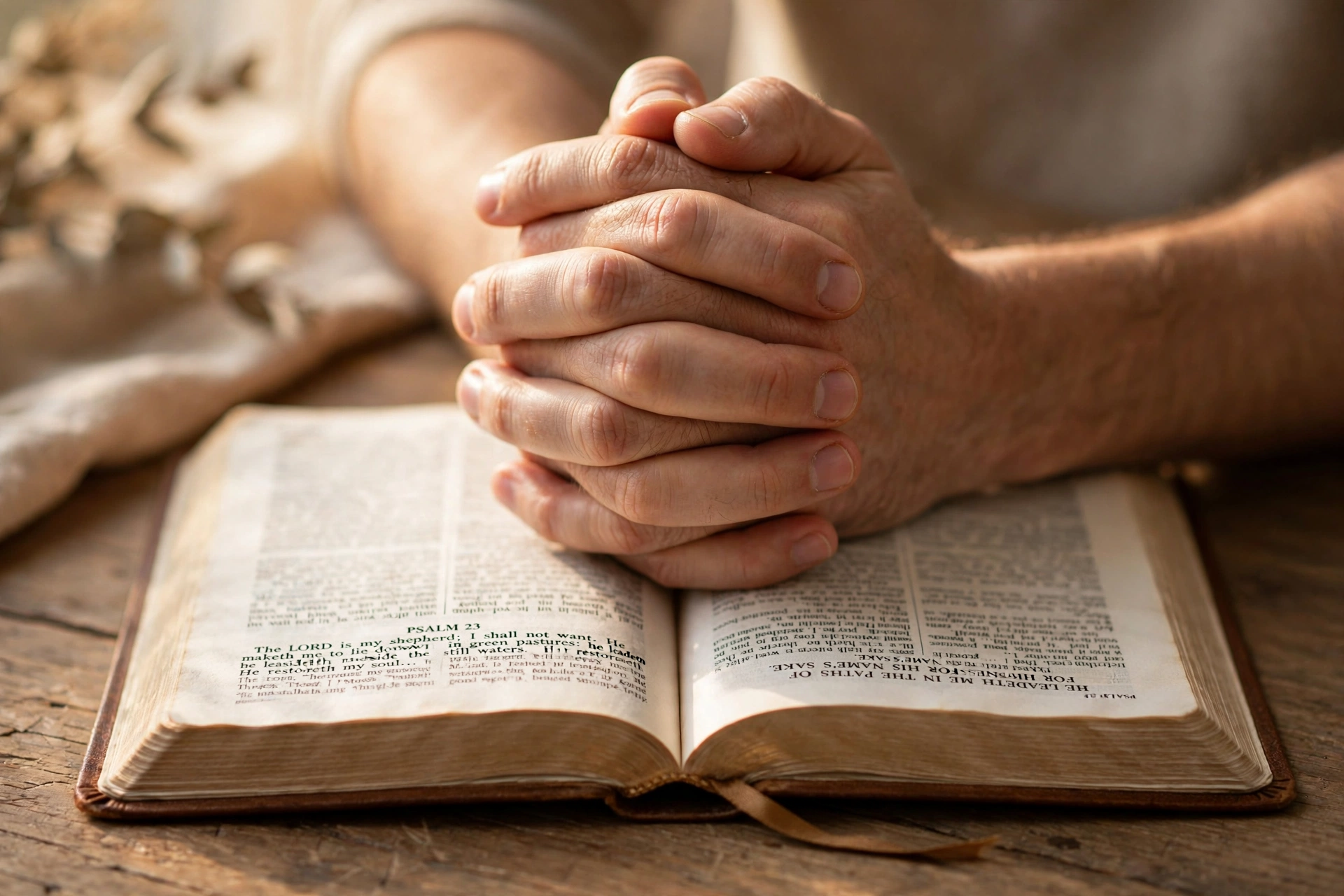
“Now faith is the substance of things hoped for, the evidence of things not seen.” Hebrews 11:1
The Epistle to the Hebrews was written to Jewish Christians who were facing severe persecution and the temptation to revert to the rituals of the Mosaic Law. The author provides this definition to encourage them to persevere by keeping their eyes on the eternal reality of Christ rather than the temporary pressures of their current suffering.
The Greek word for “substance” is hupostasis (Strong’s G5287), which literally means “that which stands under”—a foundation or a title deed. The word for “evidence” is elenchos, meaning a conviction or proof. Together, they describe faith not as a blind leap, but as a confident assurance based on the character of God.
For the modern believer, this verse serves as a spiritual anchor. It teaches us that our faith acts as a “title deed” to the promises of God. Even when circumstances seem contrary to His word, faith allows us to walk as though the promises are already reality, because they are held secure in the hand of God.
“Trust in the LORD with all thine heart; and lean not unto thine own understanding. In all thy ways acknowledge him, and he shall direct thy paths.” Proverbs 3:5-6
These verses, penned by Solomon, represent the wisdom literature of Israel, intended to guide the youth in living a life that honors the Covenant. It is a direct command to prioritize divine wisdom over human logic, especially when life’s path becomes obscured by challenges or uncertainty.
The Hebrew word for “trust” is batach (Strong’s G982), which implies a sense of safety and security in another. To “lean” (sha’an) suggests resting one’s entire weight upon a support. When we lean on our own understanding, we are like a man trying to stand on a broken reed; when we lean on God, we are standing on the Rock of Ages.
In our daily lives, this is a call to surrender our “need to know” why things are happening. The promise of direction is conditional: we must acknowledge Him in “all” our ways—not just the big decisions, but the mundane, daily habits. As we submit, He takes responsibility for our trajectory.
“For by grace are ye saved through faith; and that not of yourselves: it is the gift of God.” Ephesians 2:8
Writing to the church in Ephesus, the Apostle Paul emphasizes the total sovereignty of God in the salvation of humanity. This verse is the cornerstone of Reformation theology, clarifying that human effort, religious works, or moral pedigree can never bridge the gap between a sinful man and a holy God.
The Greek word for “faith” here is pistis, but it is important to note that even this capacity to believe is described as a “gift” (doron). We do not manufacture our own salvation; we simply receive the gift that God has provided. Our faith is the instrument of reception, not the cause of our justification.
This reality humbles the believer and eliminates pride. If our faith is a gift, we have no room to boast. This realization should cultivate a spirit of profound gratitude and cause us to walk in good works—not to earn our place, but as a natural overflow of the life-transforming gift we have received.
Key Takeaways: Bible Verses About Faith in God
| Verse Reference (KJV) | Core Spiritual Message | How to Apply Today |
|---|---|---|
| Hebrews 11:1 | Faith is the reality of the unseen. | Act on God’s promises before you see the results. |
| Proverbs 3:5-6 | Full reliance on God replaces human logic. | Pray before making decisions, even small ones. |
| Ephesians 2:8 | Salvation is a gift, not earned by works. | Release the pressure to “be good enough” for God. |
How Can I Apply Bible Verses About Faith in God in My Daily Life?
When You Feel Overwhelmed by Uncertainty
When the future seems foggy, stop trying to solve the entire puzzle at once. Practice the “one-day-at-a-time” principle of faith. Begin your morning by reading Proverbs 3:5-6 aloud. Take a physical object—like a stone or a cross—and hold it while you pray, symbolizing that you are transferring the “weight” of your anxiety onto the Lord. Ask Him for the “next right step” rather than the “final outcome.”
When You Are Facing Financial Hardship
Financial anxiety often stems from a lack of trust in God’s provision. Shift your perspective from scarcity to stewardship. Create a list of three times in your past where God provided unexpectedly. Use these as “stones of remembrance.” Every time a bill arrives or a financial worry surfaces, recite Ephesians 2:8 to remind yourself that if God gave you the greatest gift—salvation—He is certainly capable of sustaining your daily bread.
When Your Heart is Hurting in a Relationship
Relationships often test our faith because we expect people to provide the security that only God can offer. When you feel betrayed or lonely, turn to Hebrews 11:1. Remind yourself that your ultimate hope is not in the consistency of others, but in the unchanging nature of Christ. Pray for the person who hurt you, not because they deserve it, but because your faith in God frees you from the need for vengeance or bitterness.
A Prayer for Faith in God
Guided Scriptural Prayer
Heavenly Father, I come before You acknowledging that my faith is often small and easily shaken by the storms of this life. Lord, increase my faith. Help me to lean not upon my own limited understanding, but to rest my entire weight upon Your sovereign promises. When I cannot see the path forward, remind me that You are the author and finisher of my faith, and that You are already standing at the destination, waiting to lead me home.
Thank You for the gift of salvation, which I did nothing to earn and can do nothing to keep on my own. I entrust my family, my finances, and my future into Your nail-scarred hands. May my life be a testimony to Your grace, and may I walk today with the assurance that You are working all things together for my good and Your glory. In the name of Jesus Christ, my Lord and Savior, Amen.
Frequently Asked Questions About Faith in God in the Bible
Does the Bible say that faith is the only way to be saved?
Yes, the Bible is clear that faith in the finished work of Jesus Christ is the sole requirement for salvation. Romans 3:28 states, “Therefore we conclude that a man is justified by faith without the deeds of the law” (KJV). This does not mean that a believer will not perform good works, but rather that those works are the result of salvation, not the cause. Salvation is a response to the grace of God received through the channel of faith, which acknowledges that Christ’s death on the cross fully paid the penalty for our sin.
Is it a sin to have doubts while trying to have faith in God?
Doubt is a struggle common to the human condition, and it is not necessarily a sin unless it hardens into willful rebellion. In Mark 9:24 (KJV), a father cries out to Jesus, “Lord, I believe; help thou mine unbelief.” Jesus did not rebuke him for his struggle; instead, He honored his honesty and healed his child. The key is what you do with your doubt: do you use it as an excuse to turn away from God, or do you bring it to Him in prayer, asking Him to strengthen your convictions through His Word?
How does God grow our faith when life is difficult?
God uses trials as a refiner’s fire to burn away the dross of self-reliance and reveal the pure gold of genuine faith. James 1:2-3 (KJV) encourages believers to “count it all joy” when falling into various temptations, noting that “the trying of your faith worketh patience.” Just as a muscle must be stressed to become stronger, our spiritual trust is exercised through adversity. When we choose to cling to God during a crisis, our faith is validated, and we learn that He is sufficient for every situation we encounter.
What is the difference between “believing in” God and “faith in” God?
Intellectual belief is an acknowledgement of facts, whereas biblical faith is a relational commitment. James 2:19 (KJV) notes, “Thou believest that there is one God; thou doest well: the devils also believe, and tremble.” True faith, or pistis, involves a transformation of the heart and a total surrender of the will to the lordship of Christ. Believing that God exists is merely the starting point; saving faith is the active decision to entrust your eternal destiny and your daily life entirely to His care and authority.