

What Does the Bible Say About Faith in God?
The Bible teaches that faith in God is the foundational response of the human heart to His revealed truth, characterized by an active, trusting reliance on His character and promises. It is not merely an intellectual assent to facts, but a transformative, living assurance that shapes every decision and action of the believer.
In the Old Testament, the Hebrew word for faith, emunah (H530), denotes firmness, steadfastness, and fidelity. It is the quality of being “steady” in one’s reliance upon the Lord. In the New Testament, the Greek word pistis (G4102) carries the nuance of conviction, belief, and total reliance upon Christ. Scripture consistently presents faith not as a static belief, but as a dynamic, life-altering relationship that survives trials and grows through obedience.
For modern Christians, understanding faith is vital because the world often equates faith with “wishful thinking” or subjective preference. Biblical faith, however, is objective; it is anchored in the person and work of Jesus Christ. Without this grounding, believers become susceptible to anxiety, moral relativism, and spiritual instability. By studying the biblical definition of faith, we learn to shift our focus from our own limited resources to the infinite sovereignty of God.
Most Powerful Bible Verses About Faith in God (KJV)
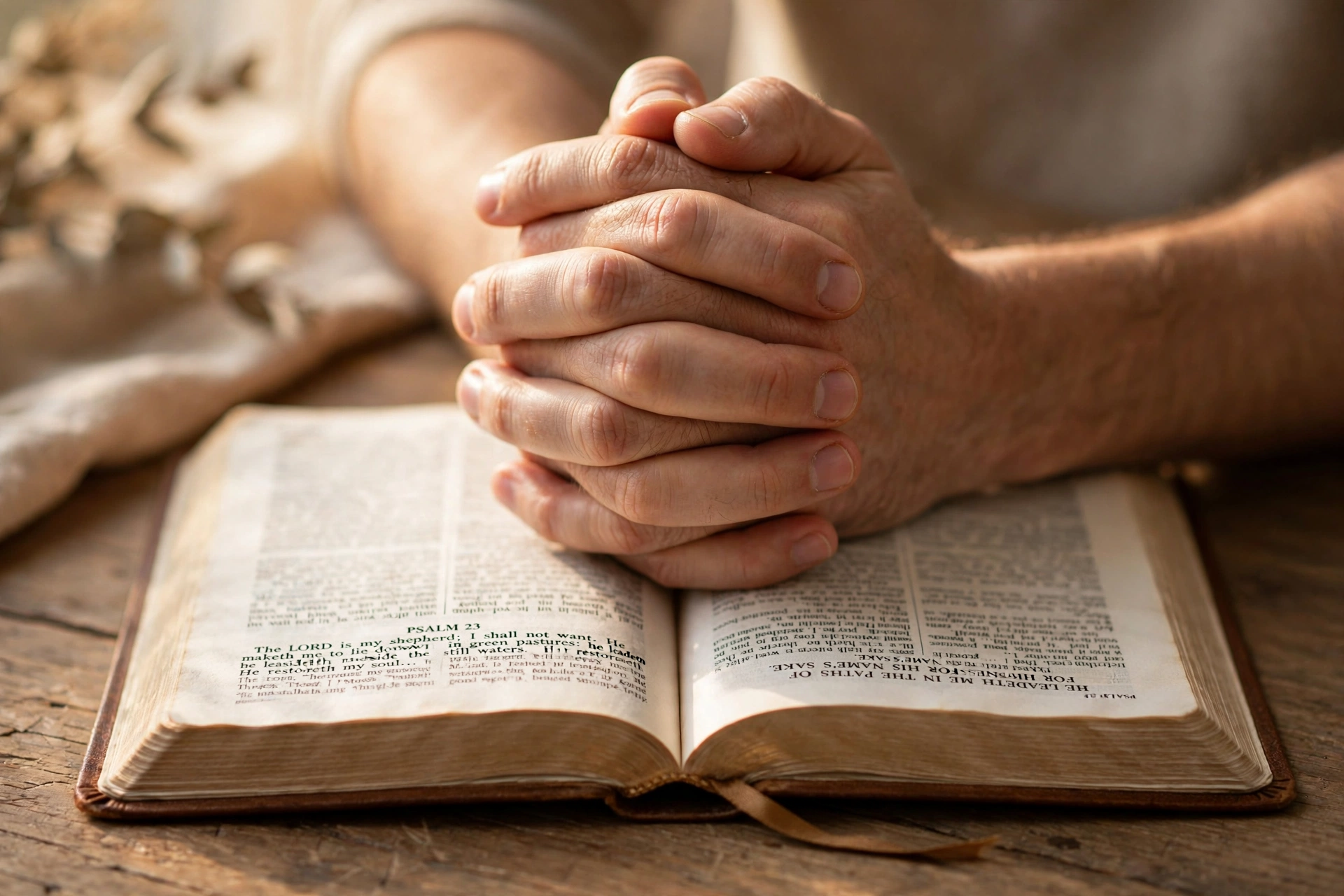
Now faith is the substance of things hoped for, the evidence of things not seen. Hebrews 11:1 (KJV)
The Epistle to the Hebrews was written to Jewish Christians who were tempted to return to the rituals of Judaism to escape persecution. The author defines faith here as the bedrock of the Christian life, providing a definition that serves as the thesis for the entire “Hall of Faith” that follows in chapter 11.
The Greek word for “substance” is hupostasis (Strong’s G5287), which literally means “that which stands under”—a foundation or guarantee. The word for “evidence” is elegchos, meaning a conviction or proof. Together, they signify that faith is not a blind leap, but a solid standing on the reality of God’s promises even when they are not yet visible to the physical eye.
In our modern lives, this verse encourages us to remain steadfast during periods of waiting. When we pray for a breakthrough or a restoration, faith acts as the “substance” that makes the unseen promises of God feel as real as the present moment. It keeps us from despair when circumstances seem to contradict what God has promised.
For we walk by faith, not by sight: 2 Corinthians 5:7 (KJV)
Paul the Apostle wrote this to the Corinthian church to contrast the temporal struggles of the earthly life with the eternal weight of glory. He emphasizes that the Christian life is a journey (walking) defined by a different set of inputs than those used by the world.
The Greek verb peripateo (“walk”) implies a continuous, habitual way of life. By choosing “faith” over “sight,” Paul is rejecting a life governed by sensory data—what we can see, feel, or measure—in favor of a life governed by the revelation of God. According to Strong’s G4102, pistis is the operative force here, acting as our “compass” in a world that prioritizes the tangible.
Practically, this means that when we face a financial crisis or a health scare, our first instinct is to look at the bank account or the medical report (sight). “Walking by faith” means acknowledging those realities while choosing to move forward based on God’s character and His promise to provide for and sustain His children.
Trust in the LORD with all thine heart; and lean not unto thine own understanding. In all thy ways acknowledge him, and he shall direct thy paths. Proverbs 3:5-6 (KJV)
King Solomon, writing to his son, offers this quintessential wisdom regarding the relationship between human intellect and divine sovereignty. It is a call to surrender the autonomy of our own reasoning to the wisdom of the Creator.
The Hebrew word for “trust” is batach (Strong’s H982), which carries the vivid imagery of throwing oneself down upon something secure. It is the opposite of “leaning” on our own understanding. The word for “acknowledge” is yada, which means to know intimately or to be acquainted with. We are not just to ask for help; we are to involve God in the very fabric of our decision-making.
This is a powerful remedy for the modern epidemic of over-analysis and burnout. When we try to “figure out” our lives entirely on our own, we become anxious. When we “acknowledge Him” in our career, marriage, and ministry, He promises to make our paths straight, removing the obstacles that our limited vision cannot see.
Key Takeaways: Bible Verses About Faith in God
| Verse Reference (KJV) | Core Spiritual Message | How to Apply Today |
|---|---|---|
| Hebrews 11:1 | Faith is the foundation of the unseen reality. | Write down your prayers and read them as “already accomplished” in God’s timing. |
| 2 Corinthians 5:7 | Don’t let circumstances dictate your direction. | When worried, pause and list three of God’s attributes to recalibrate your focus. |
| Proverbs 3:5-6 | Surrender your logic to God’s wisdom. | Pray before every major decision; invite God into the process early. |
How Can I Apply Bible Verses About Faith in God in My Daily Life?
When You Feel Overwhelmed by Uncertainty
When the future feels foggy and you are tempted to panic, treat your faith as a disciplined practice. Start by reading Bible Gateway to find verses on God’s sovereignty. Then, practice “The 5-Minute Surrender”: Sit quietly, visualize the specific problem, and mentally “place” it at the feet of Jesus. Repeat this aloud: “Lord, I do not understand the path, but I trust the Guide.” This moves your focus from the obstacle to the Overcomer.
When Your Logic Contradicts Your Calling
Often, God calls us to do things that make no sense to the world—or even to our own bank accounts. When your “own understanding” clashes with God’s nudge, use the “Obedience Journal.” Write down the prompt you feel from the Holy Spirit, then write down the logical risks. Next to the risks, write a relevant Scripture verse that promises God’s provision. Use this as a map to keep you moving forward when logic screams “stop.”
During Times of Deep Personal Loss
In seasons of grief, faith is not a feeling; it is a choice to hold on. Apply faith by maintaining your spiritual disciplines even when you “don’t feel like it.” This is called “sacrificial worship.” Set an alarm to pray for three minutes at the same time each day, regardless of your emotional state. This anchors your identity in Christ rather than in your current pain, allowing God’s peace to settle in the gaps left by your loss.
A Prayer for Faith in God
Guided Scriptural Prayer
Heavenly Father, I come before You today acknowledging that my heart is often prone to fear and my eyes are too focused on the storms around me. I ask that You strengthen my faith, that it may be a firm substance in my life, anchoring me in the truth of Your promises. Grant me the grace to walk by faith and not by sight, especially when the path ahead is obscured by uncertainty or pain.
Lord, I surrender my own understanding to Your infinite wisdom. In every way, I choose to acknowledge You as my Shepherd and my Guide. Help me to trust You with all my heart, knowing that You are working all things together for my good and Your glory. May my life be a testament to the fact that You are faithful to those who put their hope in You. In the name of Jesus Christ, I pray. Amen.
Frequently Asked Questions About Faith in God in the Bible
Does the Bible say that faith is enough to move mountains?
Yes, Jesus famously taught this in Matthew 17:20 (KJV), stating, “If ye have faith as a grain of mustard seed, ye shall say unto this mountain, Remove hence to yonder place; and it shall remove.” This is not an endorsement of “name it and claim it” theology, but a declaration of the power inherent in a living relationship with the Almighty. The “mountain” represents any seemingly impossible obstacle that stands in the way of God’s will. The emphasis is not on the size of our faith, but on the size and capability of the God in whom we place that faith.
Is it a sin to have doubts while trying to have faith?
Doubt and faith are often companions in the human experience, and the Bible provides grace for this struggle. In Mark 9:24 (KJV), a desperate father cries out, “Lord, I believe; help thou mine unbelief.” This honest confession was met with immediate compassion from Jesus. Doubt becomes a sin only when it leads to a hardened heart of rebellion against God. If your doubt leads you to seek Him more earnestly, it is a catalyst for deeper faith rather than a mark of spiritual failure.
How does God reward those who exercise faith?
The primary reward for faith is not necessarily material prosperity, but a deeper, more intimate knowledge of God Himself. Hebrews 11:6 (KJV) tells us that “he is a rewarder of them that diligently seek him.” While God often provides for our needs and grants us peace that surpasses understanding, the ultimate reward is the assurance of salvation and the transformation of our character into the image of Christ. Faith brings us into a relationship that is eternal, providing a security that the world cannot give or take away.
What is the difference between belief and biblical faith?
In the biblical sense, belief can simply mean an intellectual acknowledgement of facts—even the demons “believe” that God exists, as noted in James 2:19 (KJV). Biblical faith, however, involves the total surrender of the will and the active reliance of the soul upon God. It is a commitment that results in action. You can believe a chair will hold you without ever sitting in it, but faith is the act of sitting down. Biblical faith is an active “sitting” in the promises of God, trusting Him to support your entire life.